
Technological advancements like the rise of generative AI, blockchain and quantum computing are dominating strategic conversations in every sector. As a result, many businesses now face a situation where innovation feels like both a threat and an opportunity. Organisations must determine how they can thrive in such a rapidly evolving landscape.
The key lies in identifying the right digital, data and technology leaders. These leaders need to possess technical expertise but also align strategically with the company’s mission, values and culture. They must anticipate future trends and position the organisation to capitalise on emerging opportunities.
This guide explores some essential considerations for business leaders embarking on the mission-critical journey of hiring technology executives. We’ve highlighted key technology and data challenges for specific industries – industrials, consumer, built environment, business services, infrastructure, retail, and financial services – and the qualities technology leaders will need to convert those challenges into business opportunities.
The evolving role of digital, data and technology leadership
The days of just managing IT procurement and spend are long gone. In a world where – increasingly – every business is a digital business, the new reality is that technology, data and digital leaders are now a key driving force behind strategy and innovation. As such, they’re often charged with instigating and executing transformative changes within their organisations.
From understanding the potential of GenAI and machine learning to managing the intricacies of automation and Web 3.0, these leaders are at the forefront of leveraging cutting-edge tools and methodologies that transform businesses and create competitive advantage.
This technology and digital transformation, however, is not without its challenges.
For businesses aiming to build high-calibre technology teams capable of navigating this rapidly evolving landscape, it’s crucial to get absolute clarity on what’s needed to drive growth, while protecting the business. The chart below outlines the responsibilities for each of the key technology roles, providing a useful snapshot of what to expect from individuals in each of these positions.
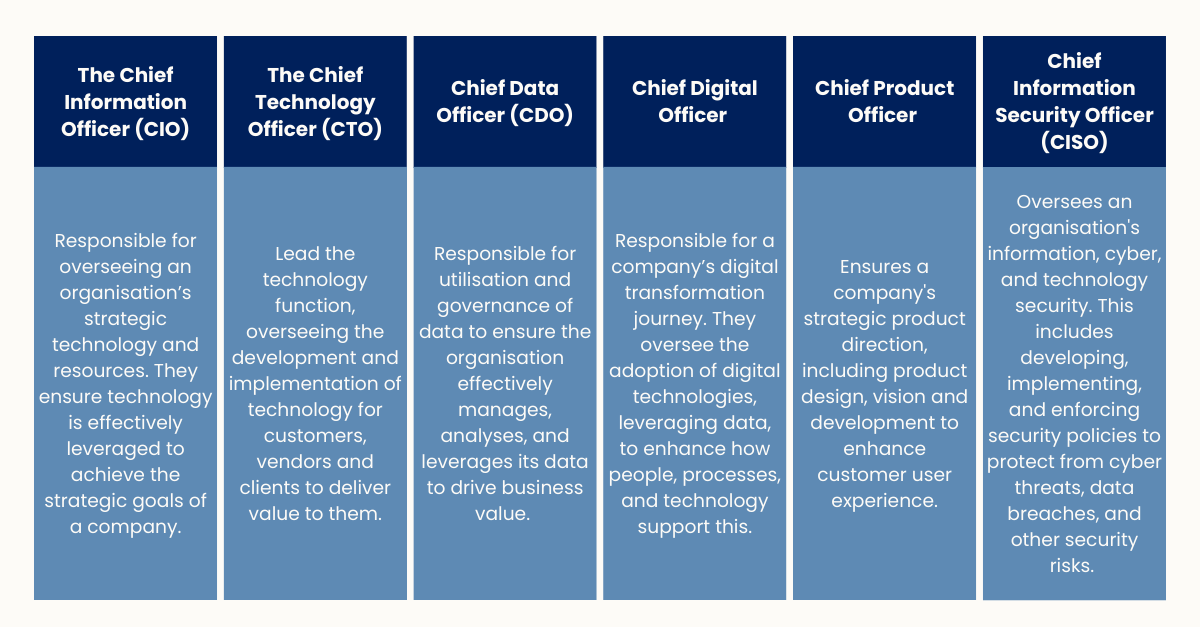
Once you’ve got a clear view of the attributes you’re seeking, you can set out to identify and attract the right person. However, when it comes to recruiting technology and digital leaders for businesses in specific sectors, it’s not just about ticking off boxes for technical skills and experience.
Instead, what’s needed is a more nuanced approach. The overarching goal is to find someone who aligns with your company’s distinctive culture and long-term vision, but also understands the intricacies of your industry. These leaders should be adept at navigating risk wisely, and engaging effectively with your various stakeholders.
You’ll need to be confident that your technology leader can be relied on to invest resources wisely, balancing capital expenditures (CapEx) and operational expenditures (OpEx). This means making decisions that drive immediate results while laying the groundwork for the long haul.
You also need to consider the importance of a global perspective. Determine to what extent your technology leader will need to understand the complexities of a globalised world, ensuring compliance with international regulations, and respecting cultural differences when making strategic decisions or leading global teams.
With a deep appreciation of all these unique factors, the right technology leaders can effectively drive innovation, support sustainable growth for your business and help you to secure a competitive edge.
Key considerations for hiring technology and digital leaders
Let’s break down and summarise the main attributes you need to keep in mind when you’re on the hunt for digital, data and technology leaders:
Commercial acumen: Today’s technology leaders need to be more than just tech-savvy – they’ve got to understand the ins and outs of the business world too, aligning technological investments and initiatives with overarching strategic objectives. Business leaders should seek candidates with a proven track record delivering tangible business outcomes – whether that’s by streamlining processes, enhancing customer experiences, or unlocking new revenue streams.
Innovation and adaptability: Success hinges on a relentless pursuit of innovation. Business leaders should prioritise candidates who are passionate about change and pushing boundaries. The most talented candidates will have a proven ability to lead transformative initiatives, experiment with new ideas, and adapt to changing market dynamics. Flexibility and resilience are key here.
Technical excellence: While vision and leadership are essential, effective technology leaders must also have a robust technical foundation from which to drive innovation and protect the business. They’re responsible for the secure deployment and operation of critical digital projects – from software development to data analytics. Cybersecurity breaches and cloud computing vulnerabilities are often where stakes are highest.
Risk appreciation: Every business has its own appetite for risk. And although technology transformations and innovation are crucial, some might prefer to take a more cautious approach to adopting new technologies. It’s essential for technology leaders to understand your risk tolerance, balancing innovation with prudent risk management, all while staying focused on budget. This could well mean prioritising projects with a clear return on investment, minimising potential for disruption and ensuring the organisation’s long-term viability.
Stakeholder engagement: Technology leaders must excel in engaging with your organisation’s broad group of stakeholders, clearly communicating the value of digital initiatives, and securing support for strategic decisions. Achieving consensus among stakeholders is vital for the successful implementation of digital and technology strategies.
Cultural alignment: As crucial as technical expertise and strategic skills are, cultural compatibility is equally vital in ensuring the success of technology. Prospective candidates should understand and respect your core business values and culture.
As industries evolve, the role of technology leaders becomes crucial in transforming challenges into opportunities. We outline some of the vital qualities and skills needed across different sectors:
INDUSTRIALS

Leaders in the industrials sector need to be ready to develop programs that will equip your workforce with the necessary skills to integrate seamlessly with automation and AI-powered systems. They must also have a clear strategic vision to leverage technology innovations for building a flexible, responsive supply chain, resilient to disruptions. Understanding and managing the unique cybersecurity risks associated with interconnected systems is also key.
Desirable skills and qualities include:
- Industrial automation & robotics: Ability to implement robotic automation solutions to enhance efficiency, safety and throughput in manufacturing processes.
- Supply chain resilience: Experience in supporting the development of resilient, agile and adaptable supply chains that can ride out disruptions.
- Cybersecurity for industrial systems: A deep understanding of cybersecurity best practices and securing business-critical industrial control systems against evolving threats.
- Predictive maintenance: Championing the use of AI-powered predictive maintenance solutions to identify potential equipment failures and schedule maintenance proactively.
CONSUMER

Consumers today are tech-savvy and their demands are constantly evolving. To stay ahead, your ideal technology leader in the consumer sector needs to be a data-driven innovator who prioritises customer experience while upholding responsible data practices.
This leader should have a deep understanding of how user data can be leveraged to drive differentiation through hyper-personalisation and ultra-responsive campaign management. Building and maintaining consumer trust by implementing robust data protection practices is also crucial. Additionally, embracing agility and a culture of innovation are essential for keeping pace with shifting consumer behaviours and ongoing technological advancements.
Data fluency is essential, along with a deep understanding of data analytics and how it can be used to inform your strategy and drive decision-making. And as GenAI and automation transform businesses, technology leaders will need to be skilled in managing a changing workforce and develop strategies for integrating these disruptive technologies and upskilling their people.
Desirable skills and qualities include:
- Customer-centric mindset: A deep understanding of consumer behaviour and how to create seamless, personalised experiences across all touchpoints.
- Data ethics: Experience in navigating the delicate balance between personalisation and data privacy regulations and implementing ethical data practices.
- AI governance: Understanding of responsible AI use, and fairness and unbiased decision-making in algorithmic systems.
- Omnichannel strategy: Customers expect a unified and seamless customer experience encompassing online and physical channels. Technology leaders need to master blending these channels for maximum customer satisfaction, creating a seamless and personalised customer journey.
INFRASTRUCTURE

Technology leaders should be deeply experienced in leveraging data to optimise infrastructure operations and resource allocation. They need to understand how to use this data to make strategic investments in the right technologies for optimising infrastructure performance and resilience, while balancing innovation and security.
Leaders should also be aware of the role robotics can play in transforming infrastructure management. Robotics can automate routine tasks such as inspections, maintenance, and repairs, significantly boosting efficiency and safety.
These leaders should be skilled at navigating the complexities of Operational Technology (OT), identifying potential cyber-attack vectors to safeguard critical infrastructure systems and enhance infrastructure reliability.
Desirable skills and qualities include:
- Data-driven decision-making: Leveraging data and advanced technologies like analytics and AI to optimise infrastructure operations and resource allocation.
- Risk-aware innovation: Embracing tech innovation, including robotics, while prioritising the security of critical infrastructure and operational control systems.
- Sustainability integration: Developing and implementing sustainable infrastructure technology solutions that minimise environmental impacts.
- Predictive maintenance: Leveraging AI, analytics and sensors for proactive maintenance to avoid breakdowns and extend infrastructure lifespan.
BUILT ENVIRONMENT

Your ideal technology leader needs to be a collaborative visionary who can understand the nuances of complex projects, and the value of cutting-edge technologies in driving these projects forward. Also essential is a clear vision for how technology can shape sustainable practices in various types of built environments, whether urban, rural, or industrial. This involves leveraging technologies that improve resource efficiency, reduce carbon footprints, and support resilient infrastructure development.
Desirable skills and qualities include:
- Digital innovation: A deep understanding of digital construction tools – like 3D printing, BIM and more – to enhance efficiency and productivity on construction projects.
- Future vision: A clear view of how technology and data analytics can help to shape and operate more liveable, environmentally responsible buildings.
- Smart city integration: Expertise in integrating digital technologies like IoT and AI solutions to create modern, sustainable, human-centric urban environments.
- Risk management: Understanding and mitigating risks in projects and across assets – including the threat of cyberattacks on infrastructure and operations.
BUSINESS SERVICES

Leaders will need to be able to lead through change, effectively communicating and managing the impacts of technology and digital transformation on the whole enterprise. This will include employee training and development to prepare people for a changing work environment. Another priority must be instilling a culture of cybersecurity awareness at every level throughout the organisation.
Desirable skills and qualities include:
- Leading through change: Leading through digital transformation requires clear communication, strategic planning, and the ability to manage ongoing and pervasive impacts on all aspects of the business.
- Automation: Understanding how to leverage technologies like AI to automate operations and streamline business processes while maximising workforce efficiency.
- Prioritising cybersecurity awareness: The rise of remote work and interconnected systems means that protecting sensitive business data and instilling a culture of security awareness is essential.

FINANCIAL SERVICES
As a financial services business, it’s essential that your technology leader is finely attuned to regulatory developments impacting all aspects of the industry, and not just in FinTech. The ability to embrace innovation while managing cybersecurity and financial risks is key in this sector. So is a laser focus on the customer experience. Achieving comprehensive visibility into each customer requires seamless, enterprise-wide data flow, making the transition to the cloud a likely top priority.
Desirable skills and qualities include:
- Strategy innovation and risk management: To achieve business objectives, leaders need to balance the drive for new technologies with mitigating cybersecurity and financial risks.
- Navigating regulatory complexities: Keeping abreast of evolving regulations – including on resilience requirements – while ensuring all technology initiatives support strong governance and regulatory compliance.
- Focus on the customer experience: Leveraging data-driven technologies like AI and analytics to enhance the customer’s journey and experience.
- Fraud detection and prevention: Developing AI-powered systems to detect, tackle and prevent fraudulent transactions and behaviour.
Attracting and retaining technology and digital leaders
Demand for skilled technology professionals far outstrips supply. Attracting and retaining top talent requires:
- focusing on high-calibre leaders who have real commercial insight, cultural alignment, innovative thinking and deep technical expertise.
- technology leaders also need to excel at future-proofing their teams; by strategically balancing external hires with robust internal training programs, they can develop a workforce equipped to navigate the evolving technological landscape.
Technology leaders who tick all of these boxes can play a key role in positioning your business for sustained success.
At Redgrave, we specialise in connecting businesses with world-class technology leadership. Our dedicated Digital, Data & Technology practice ensures deep functional expertise and unrivalled understanding of the nuanced and evolving requirements of technology leadership roles in today’s world.
We’re dedicated to identifying and connecting you with exceptional talent that aligns with the evolving opportunities and challenges facing your business. We focus on finding leaders who combine the expertise to lead organisations into the future with the confidence and cultural compatibility needed to integrate seamlessly into your unique business environment.
For more insights on how we partner with businesses to attract great digital, data and technology leaders, please contact Rind Bajwa or David Angel.