

The environment for CEOs continues to change as stakeholder demands increase and market volatility persists. The need for strong leadership is more critical than ever. Whether despite or because of these changes, there are some noteworthy trends when it comes to CEO succession in financial services. We explore some of these trends in our most recent annual CEO Succession Trends report, which focuses on banking, insurance and wealth management in the UK.
CEO Turnover
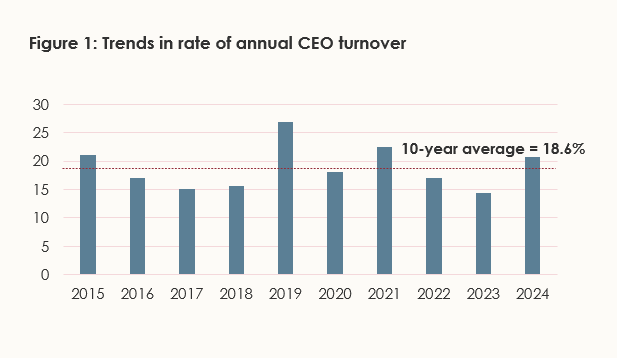
That last year’s CEO turnover was a higher-than-average 20.7% is not surprising given that three of the previous four years saw below average rates of CEO turnover (including last year’s lowest-rate-in-the-last-10-years of 14.3%).
Cross-sector variances
As in previous reports, we compare CEO turnover trends between the segments of UK financial services – this includes:
Retail and SME banking
General insurance
Life, pensions and retirement
Wealth and asset management
Please note that, where a company operates in more than one segment (e.g. Aviva, Lloyds Banking Group etc.), we’ve included that company in all of the segments in which it operates.

At 22.4%, 2024 saw the second highest rate of CEO turnover over the last decade in the retail and SME banking segment. There were leadership changes at two of the largest high street banks – with Vim Maru moving to become CEO at Barclays UK and Jose Carvalho joining HSBC to lead its UK Wealth and Personal Banking business. Long-awaited M&A activity precipitated a couple of appointments, with Chris Rhodes moving from being Nationwide Building Society’s CFO to become the acquired Virgin Money’s new CEO, and Richard Henderson stepping-up from CFO to run Tesco Bank within Barclays. Other notable appointments include Gail Coldie (Bank of Ireland UK), Raman Bhatia (Starling Bank) and Richard Rowntree (Together). In 2024, despite intense CEO succession activity across medium-sized and smaller building societies (which were not reviewed in this report), there were no CEO changes across the top ten building societies.
Always relatively volatile, especially in personal lines, the general insurance segment saw – at 21.4% – one of the highest ever rates of CEO churn in 2024. There were appointments at many of the larger personal lines providers – notably Alistair Hargreaves (Admiral UK), Serge Raffard (Allianz UK Personal Lines), Alain Zweibrucker (AXA UK Retail) and Adam Winslow (Direct Line Group). In addition, there were new CEOs at businesses such as Aon UK (Jane Keilty), ManyPets (Luisa Barile), Homeserve (Nick Kasmir) and Gallagher UK Retail (Nick Harris).
Historically, in life, pensions and retirement, the rate of CEO turnover has been characterised mostly by modest levels, but with occasional years of intense activity – for example, in 2019 and 2021. While last year saw new CEOs at, for example, Legal & General (Antonio Simoes), Zurich UK (Drazan Jaksic) and Simplyhealth (Paul Schreier), 2024 was another one of those unexceptional years.
Similarly, the rate of CEO turnover in wealth and asset management is generally moderate but there are occasional years with exceptionally high levels of activity – for example, 2017, 2020 and 2022. While 2024 was an unexceptional year new CEOs were appointed by abrdn (Jason Windsor), Brooks Macdonald (Andrea Montague) and Sesame Banhall Group (Richard Harrison). There was also an interim CEO appointment at the Cinven-owned wealth manager, True Potential – however, it was also announced that Gerry Mallon (formerly CEO at Tesco Bank) would be joining as the firm’s permanent CEO in early 2025.
Tenure (as at 31 December 2024)
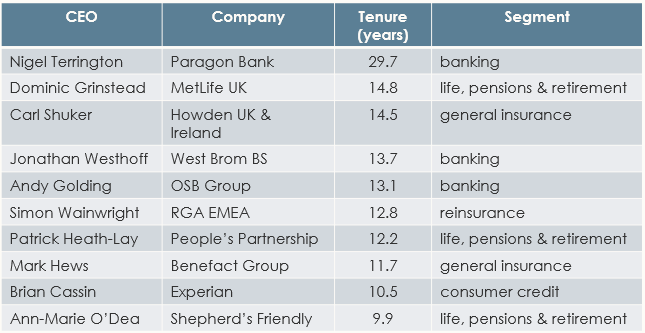
With admirable longevity and continued energy, nine of the CEOs highlighted in last year’s ‘top 10’ longest-serving list remain in this year’s list. We note that this list contains four CEOs from businesses without shareholders – notably, Benefact Group (charity-owned), People’s Partnership, Shepherds Friendly and West Brom Building Society.
Role before CEO
Here, we look at the roles CEOs held immediately before they stepped into their current positions. The proportion of CEOs who transitioned from another business leadership roles has stabilised at just under three quarters – i.e. 73.7%, 73.5% and 74% for 2024, 2023 and 2022 respectively. Clearly, when replacing a CEO, there is little substitute for previous business and/or P&L leadership experience.
73.7%
2024
73.5%
2023
74%
2022

While inflation has fallen close to target and interest rates have peaked, 2024 saw a persistent cost-of-living crisis in the UK, energy prices remained high (due mainly to the war in Ukraine), uncertainty of elections in both the UK and the US, and considerable volatility in the Middle East. Not quite a perfect storm, but certainly an unhelpful combination of economic headwinds.
Historically, CFOs have been seen as steady hands on the tiller during difficult economic times. The challenges of 2024 were reflected by the fact that over one fifth (20.6%) of the new CEOs appointed across the 150 firms surveyed were promoted from CFO. Current CEOs who stepped-up from CFO in the last 12 months include Jason Windsor (abrdn), Andrea Montague (Brooks Macdonald) and Georges Elhedery (HSBC). Nevertheless, with several CEOs (who were former CFOs) having left their roles, the proportion of CEOs who have been promoted from CFO was just 12.8%.
In the highly regulated UK financial services sector, Boards can feel pressure to conduct a comprehensive market search during a CEO succession event. When awarded such a mandate, Redgrave (or any competent executive search partner) will deliver a shortlist of candidates with strong business leadership credentials. However, even a well-regarded CFO with a solid reputation and established relationships with the Board might become considered a ‘left field’ candidate if they lack prior business leadership experience. Of course, this view can be mitigated if the CFO has gained P&L leadership experience, either before becoming CFO or concurrently with their finance leadership responsibilities.
Taking on an external non-executive directorship can also help mitigate a lack of P&L leadership experience. Serving as an iNED can enhance personal reputations and strengthen the CFO’s credibility and promotion prospects. In fact, evidence shows that approximately 50% of former CFOs who are now operating in CEO roles became a NED during their CFO tenure.
Diversity, Equity & Inclusion (DE&I)
It’s clear that fostering a diverse and inclusive culture enables a better response to customers’ ever-changing needs and is therefore fundamental to long-term business success. Cranfield University’s Female FTSE Board Report, published in November 2024, highlights that the proportion of women in NED roles at FTSE100 and FTSE250 companies sits at 43.4% and 42.4% respectively.
The report also highlighted that 74 FTSE100 and 174 FTSE250 companies have already met or exceeded the Women Leaders Review target of having 40% women on the Board by 2025. For another year, the financial services sector fared relatively well against these targets, as represented by Aviva, Hargreaves Lansdown, HSBC, Lloyds Banking Group and Schroders all reporting Boards comprising at least 50% women.
Cranfield’s report showed that only 16 FTSE100 companies have a woman Chair – a reduction from the 18 Chairs reported in the previous Report. Of the FTSE100 constituents with women Chairs, financial services companies represented 31.3% – including Bea Hollond (F&C Investment Trust), Alison Platt (Hargreaves Lansdown), Joanne Segars (Legal & General), Baroness Shriti Vadera (Prudential) and Dame Elizabeth Corley (Schroders).
The trend seen in the FTSE100 is echoed across the FTSE250, with only 14% of FTSE250 companies having a woman Chair, which is identical to the proportion highlighted in the previous report. Including investment trusts, 37.1% of FTSE250 companies with a woman Chair now operate within financial services – these include Fiona Clutterbuck (AJ Bell), Danuta Gray (Direct Line), Anne Wade (Jupiter Fund Management) and Ruth Markland (Quilter).
Across both FTSE100 and FTSE250 companies, however, gender parity has been achieved in Senior Independent Director (SID) appointments for the very first time. This provides optimism for increased representation of women in Chair roles in the future. Nevertheless, Redgrave sounds a note of caution. In 2022, the Women Leaders Review set a new target that FTSE350 companies should aim to appoint at least one woman in one of the four top roles (Chair, CEO, CFO and SID). We believe that, unsurprisingly, some companies have chosen to focus on the easiest of these roles to fill – i.e. the SID role.
While all progress is good progress, Anne Minto OBE, Chair, IWF, shares her view:
“While I am very pleased to note the progress being made on the appointment of women to FTSE 350 Board positions, the reduction in the number of women in Chair roles is disappointing. There is still a lack of women executive directors on Boards and Executive Committees and more needs to be done to appoint talented women into senior operational roles.”
– Anne Minto OBE, Chair, IWF
The statistics below endorse her point.
The Cranfield report highlights that, since the publication of the previous Report, the number of women holding executive directorships at FTSE100 companies has moved positively – from 36 to 41. As a result, the percentage of female Executive Directors increased to a record 20.3%.This growth is largely reflected by an increased turnover of CFOs and a corresponding rise in the appointment of women into FTSE 100 CFO roles. Financial services companies within the FTSE100 more than hold their own in this regard, with Aviva, Barclays, Beazley, Hargreaves Lansdown, M&G and NatWest Group all employing women in CFO roles. Aviva deserves a particular mention, as it is one of just five companies that employs women in both CEO and CFO roles – Amanda Blanc and Charlotte Jones respectively.
Despite this, the relative lack of women holding Executive Director roles remains concerning. In fact, across FTSE250 companies, there was a decrease in the number of women in such roles – from 47 to 42. As a result, women hold just under 12% of Executive Director roles across FTSE250 companies. Again, financial services compares well to many other sectors with the following women serving as Executive Directors – Jo Musselle (Hiscox), Natalie Kershaw (Lancashire Holdings), Victoria Hyde (OSB Group) and Michelle Grew (Man Group).
As of 31st December 2024, 16.9% of the CEOs at the financial services companies surveyed by Redgrave were women. This is a disappointing fall from the peak of 18.5% at the end of 2022. On the positive side, established CEOs, such as the aforementioned Amanda Blanc, Debbie Crosbie (Nationwide BS), Susan Allen (Yorkshire BS), Francesca Carlesi (Revolut UK) and Nici Audhlam-Gardiner (Foresters Financial) were joined by the following women in senior leadership roles:

Jane Keilty – Jane took on her current role in January 2024 after Aon brought together its UK and EMEA regions under the leadership of Julie Page. Jane joined Aon in 2005 and, immediately before her most recent promotion, she had been Head of UK Commercial Risk.

Heather Smith – before joining AXA in January 2024, Heather had been leading Allianz UK’s retail business, which provided personal lines insurance for 3.7m customers. Before Allianz, Heather had worked for Aviva in a series of commercial leadership roles across general, life and health insurance.

Gail Goldie – Gail was appointed in January 2024 to lead the delivery of the next phase of Bank of Ireland’s UK strategy. She joined from Tesco Bank where she served as Chief Banking Officer. Prior to that, she held senior management positions in Barclays UK, which included leading unsecured lending and premier banking businesses. Gail also previously held leadership roles in Santander UK and Amex.

Andrea Montague – Andrea joined the c£20bn under management wealth manager as CFO in June 2023. Her appointment as Group CEO was announced in June last year and came into effect in October. Previously, Andrea served on the ExCo of Aviva as Group CRO and, before that, held senior finance leadership roles at Aviva, Royal London & Standard Life.

Luisa Barile – an ex-McKinsey Strategy Consultant, Luisa has a wealth of knowledge across the general insurance market. Luisa joined the UK’s first insurtech, ManyPets (at the time, known as Bought by Many), as CFO in 2018. In 2023, she became UK CEO and, in April last year, she stepped-up to become Group CEO.

Emma Ferris – having qualified as an Actuary with Towers Watson, Emma joined AXA UK in 2010. Here she worked in a range of risk, ALM and capital management roles, including spending 12 months as UK Chief Risk Officer. She joined RGA at the beginning of 2018 and led acquisitions and business development efforts across EMEA before stepping into her current role to lead the UK & Ireland business.

Laura Mason – last October, it was announced that Laura would move from being CEO of L&G Capital to lead the Retail division, which supports the savings, protection and retirement needs of approximately 14m customers. Laura remains on the Group Management Committee and continues to chair L&G’s Global Diversity & Inclusion Council.
It is perhaps fitting that the Cranfield 2024 Female FTSE Board Report is sub-titled ’25 years on: Milestones & Misses’. Anna Anthony, Managing Partner at EY’s UK Financial Services practice, says in the Sponsor’s foreword:
“I was pleased to see that the number of female board directors in FTSE 100 and FTSE 250 companies has increased… although women still remain firmly in the minority. What is particularly concerning, however, is that the sub-group of women in executive positions – such as Chairs, CEOs and CFOs – hasn’t seen the same progress. This level of decline will be hard to recoup and will take time and focus to counteract”.
– Anna Anthony, Managing Partner at EY’s UK Financial Services practice
Of course, Redgrave believes that firms should focus on appointing the best candidate for all senior appointments based on merit and cultural alignment. Having said this, for diversity to progress at the leadership level, we recommend that organisations consider ways to create opportunities for talented women into divisional Managing Director or Chief Commercial Officer-type roles, as a pathway to broader leadership positions.
During searches of this nature, efforts to promote diversity should focus on the candidate identification and long-listing phases of process. Employers should be diligent in ensuring that their chosen search partner actively supports the DE&I agenda, while demonstrating the flexibility to search broadly across multiple markets to optimise the likelihood of a diverse and highly qualified shortlist being delivered. At Redgrave, we are committed to conducting inclusive search processes that consistently outperform the market on DE&I objectives. Since 2020, more than two-thirds of all appointments made by our Financial Services practice have been women or from minority ethnic groups.
Expectations for 2025
The consensus seems to be that UK economic growth will improve, though will remain sluggish during 2025. The Bank of England’s current prediction is that GDP will grow by 1.5%, and other predictions range from 1.2% (Goldman Sachs) to 1.7% (KPMG). That the UK is likely to outperform its peers in the eurozone is cold comfort as, at the low end of expectations, growth will be too slow to avert the need for further spending cuts, or even tax rises, during this parliament.
Inflation is likely to remain stubbornly above the 2% target for the foreseeable future and, as sentiment about the economic outlook has worsened, consumer and business confidence has fallen. Higher than expected inflation and falling economic confidence both limit scope for the Bank of England to cut interest rates. Nevertheless, we’ve been in the midst of a loosening cycle, and pundits still forecast two or three additional rate cuts in 2025. So, it seems likely that we’ll end the year with a base rate either 4% or 4.25%.
While there’s no direct correlation between base rate, cost of capital and liquidity and lower interest rates are likely to precipitate increased M&A activity by private equity (PE) funds. The second half of last year saw promising green shoots, after falling valuations in 2023 had removed the financial incentive for PE owners to sell assets. There’s no shortage of dry powder, especially in the large cap market, and opportunities to deploy this investment need to be found.
There may be exceptions, but in financial services, Redgrave predicts that PE funds will be more interested in investing to support roll-up/consolidation opportunities in general insurance brokerage or wealth advice, than they will in lending-focused businesses or capital intensive markets, such as life insurance. PE funds often replace the CEOs and/or CFOs of recently acquired businesses and therefore, with an increase in M&A activity, we can expect a consequent increase in the rate of CEO change.
With this in mind, we expect that 2025 will be another year where the rate of CEO change will be above average, driven especially by activity in general insurance and wealth management. While 2025 will remain hard going, we don’t expect a profound increase in the proportion of CEOs who are promoted from CFO over the coming 12 months. However, one CFO-to-CEO change has already been confirmed in 2025, with Mike Morgan stepping-up too become Close Brothers’ new CEO.
The author, Conrad Hills, has more than 20 years’ executive and non-executive search experience. Conrad leads Redgrave’s Financial Services practice, advising retail/SME banks, life, pensions and retirement firms, general insurers and wealth/asset managers on Board and ExCo appointments, as well as on how to identify and hire talented leaders with ExCo potential.
About Redgrave
A global search firm with a focus on building long-term trusted relationships that go beyond delivery. We advise clients, across most sectors and all ownership models, on Board and Executive Committee (ExCo) appointments, as well as on attracting talented leaders with ExCo potential. Our Financial Services practice operates across retail/SME banking, insurance and wealth/asset management. In 2024, we advised clients on a range of CEO and CFO roles and helped several well-known leaders segue from executive to non-executive careers. What sets us apart from the rest of the industry is that we are:
- Insight-driven: we have an unparalleled knowledge of the markets in which we operate; we understand the challenges and how to overcome them.
- Bold and advisory: we have the confidence to challenge clients’ preconceptions; we partner proactivity with our clients to define pragmatic solutions and search strategies.
- Results-oriented: We bring our clients the best global talent through an approach that’s collaborative, straight-talking and focused on long-term results.


