There isn’t a single playbook for the journey from Chief People Officer to Non-Executive Director.
But there is a pattern.
In partnership with Wondrous:
Co-founder, Wondrous

Associate Business Consultant, Wondrous
The transition requires patience, deliberate preparation and, most importantly, a shift in how you think about your role, your value and your contribution. Not only in pursuit of a board seat, but in how you operate today.
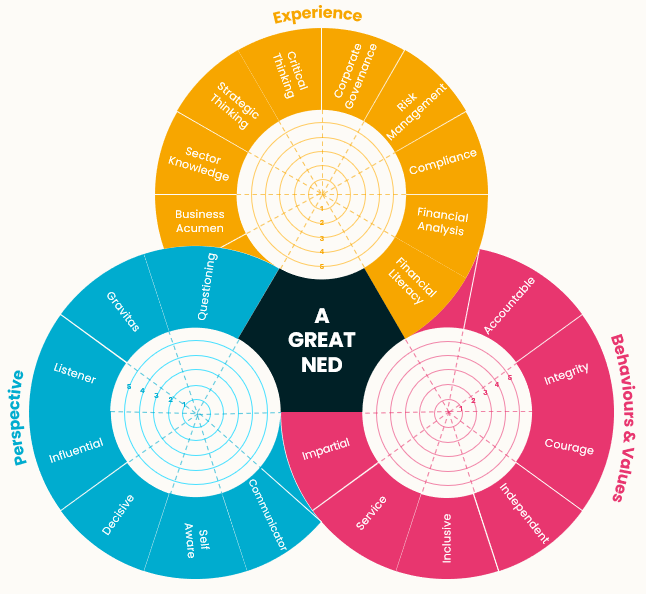
When we first partnered with Wondrous and brought together senior People leaders last year to explore the transition from CPO to NED, the focus was on readiness, exposure, skills and mindset – themes that align with the three core elements of a great NED: Experience, Perspective and Behaviours.
At our most recent session, those themes remained, but the conversation moved somewhere deeper.
© Wondrous People Ltd 2026. All rights reserved. A Great NED™ is a proprietary methodology of Wondrous People Ltd.
A Wondrous Model: The three core elements of a great NED
This framework helps decode what boards are really looking for, beyond credentials.
Experience forms the foundation, and Perspective and Behaviours elevate influence and shape impact at board level.
Created by a Wondrous panel of board‑level practitioners, this framework helps decode what boards are really looking for – beyond credentials.
Experience forms the foundation. Perspective and Behaviours elevate influence and shape impact at board level.
Leaders are no longer asking: “What do I need to do?” but “How do I need to think?”
That matters because experience forms the foundation, but Perspective and Behaviours are what shape influence and impact at board level.
This article reflects that evolution. It places greater emphasis on perspective and judgement, not because experience and behaviours matter less, but because what ultimately differentiates great CPOs in the boardroom is how they think, question and contribute.
The habits, mindset and visibility required for board level influence are rarely developed overnight. Building that perspective while still in an executive role helps ensure that CPO capability translates into strategic value, not only in the boardroom, but in every situation where important decisions are made.
Step One: What Shift Must a CPO Make for Board Readiness?
From Answers to Questions
Too often we enjoy the comfort of opinion without the discomfort of thought.
— John F. Kennedy
It’s a distinction that sits at the heart of the executive to non-executive transition.
As an executive, you are paid to provide answers.
As a Non-Executive Director, your value lies in asking the right questions, often the uncomfortable ones. It’s less about certainty or expertise, and more about judgement, curiosity and the ability to challenge thinking without derailing progress.
For many CPOs, this means shifting from solving the problem to shaping the conversation: pausing, probing and testing assumptions rather than steering the answer.
In practice, this looks like:
01
Moving from solution-led contributions to questions that surface assumptions, trade-offs and unintended consequences – prompts such as, “What assumptions are we making here?” or “Where might the risks emerge first?”
02
Using experience to broaden the discussion rather than closing it down too quickly
03
Creating space for alternative viewpoints instead of converging suddenly
This shift often makes the difference between experience that is respected and experience that is genuinely trusted and influential in a boardroom context.
Step Two: How Can CPOs Build Strategic Perspective as a Leadership Capability?
Not a Trait, but a Discipline
Perspective comes up a lot in conversations with senior People leaders – not as a fixed personal quality, but as an active capability that must be developed and practiced.
CPOs are often catalysts of perspective shifts within organisations. They help leadership teams navigate change, challenge entrenched thinking and adapt to new realities. The move towards a NED role, however, requires something additional: the ability to consciously shift your own perspective.
Context matters, so does time horizon. Balancing short-term priorities with long term value, executive realities with boardroom oversight, growth ambitions with risk discipline.
Boards value leaders who can hold these tensions without rushing to resolution.
Practically, this involves:
Building a Board-ready profile isn’t just about experience. It’s about intentional growth. Start by identifying the core competencies. Then treat your development like a sprint: set clear milestones, allocate resources, and track progress as you broaden your leadership toolkit.
Consider the following focus areas:
01
Learning to look beyond the immediate operating cycle towards the strategic horizon
02
Becoming comfortable with ambiguity and competing truths
03
Adjusting your contribution depending on whether the need is challenge, support or restraint
Perspective is less about having the right answer and more about seeing the landscape clearly enough to ask the right questions.
Step Three: Why Boards Are Paying More Attention to Human Dynamics
Why the Human Lens Matters
Boards increasingly recognise that many strategic failures are not failures of strategy itself, but failures of execution, behaviour or organisational alignment.
However sophisticated technology becomes, strategy is still delivered through people, their judgement, leadership, capability and willingness to adapt.
Historically, many boards had limited visibility into the customer experience. Over time, directors with strong customer and market insight became more common, bringing valuable perspective on how strategy translated into value for end users.
We’re seeing a similar shift emerge around human and organisational dynamics.
Boards are increasingly interested in leaders who can help them understand how culture, leadership behaviour, workforce capability and organisational design shape commercial outcomes. This is where CPOs can add distinctive value.
Their perspective spans culture, capability, behaviour and organisational sustainability. Far from diverting attention from commercial priorities, this lens strengthens board decision-making by grounding strategy in how organisations actually function.
This becomes particularly visible in moments of strategic tension: large-scale transformation where leadership behaviour determines execution, periods of rapid growth where culture can dilute faster than capability builds, or restructuring decisions where short-term cost discipline risks eroding long-term organisational strength.
Technology will continue to shape strategy.
Human dynamics will determine whether it succeeds.
For CPOs, this means:
01
Helping boards understand how leadership behaviour, culture and organisational capability shape the organisation’s ability to execute strategy
02
Connecting people dynamics directly to risk, resilience and long-term value creation, not as a separate “people agenda”, but as a driver of commercial outcomes
03
Bringing early visibility to organisational signals, shifts in leadership alignment, cultural drift or capability gaps, before they surface as strategic or operational failures
Step Four: What Distinguishes Board Level Judgement from Operational Experience?
Experience as Context, Not Control
Experience still matters, but not in the way many assume.
At board level, experience is less about demonstrating expertise and more about applying it with judgement. The value lies not in having the answer, but in using context to inform the right questions and trade-offs.
For CPO’s, this includes understanding board dynamics, governance expectations and investor priorities, particularly in environments such as private equity where pace, scrutiny and expectations for value creation are heightened. Developing this fluency allows CPOs to operate as more effective advisors to CEOs and Chairs, helping leadership teams navigate both organisational realities and board expectations.
Importantly, board awareness and fluency is not only relevant for those pursuing a future NED role. CPOs who develop a board lens tend to make sharper strategic trade-offs, frame culture and capability through a value-creation perspective, and support CEOs in navigating governance complexity with greater confidence.
In practice, this might mean:
01
Anticipating emerging issues, such as leadership succession, workforce risk, or reputational exposure, before they surface on the board agenda.
02
Supporting CEOs and leadership teams in navigating board dynamics and governance expectation, not just operational delivery.
03
Adapting communication and framing to match board-level decision cycles, particularly where pace and scrutiny are high.
Step Five: How Do CPOs Turn Board Readiness into Real Opportunity?
Making Capability Visible
Many aspiring NEDs already possess the capabilities boards value. The next step is ensuring that capability is visible, understood and trusted.
One of the most common misconceptions is that board roles are pursued in the same way as executive roles – through a defined job search when the timing feels right. In practice, board appointments rarely work this way.
Board opportunities emerge through long-established professional relationships and reputational signals and personal profile, built over time.
Former colleagues, CEO’s, investors, search partners, advisors and industry peers often play an important role in surfacing candidates, pointing Boards towards individuals whose judgement they trust.
For CPO’s, turning readiness into opportunity is rarely a single step and involves being deliberate about how that professional reputation and visibility develop over time.
In practice, this might involve:
01
Investing selectively in governance and board-focused education to deepen judgement, rather than to accumulate credentials.
02
Cultivating a long-term diverse network of trusted relationships across colleagues, executives, investors, advisors and industry leaders, people who recognise your judgement and will advocate for you.
03
Articulating a clear board narrative that reflects how you think and contribute, not simply the roles you’ve held.
04
Increasing visibility through thoughtful contributions, through writing, panels or industry dialogue, demonstrating judgement and perspective.
Developing relationships with search firms and advisors involved in board appointments, recognising that many roles emerge through trusted recommendation rather than formal processes. Board opportunities rarely appear on demand. More often, they arise when individuals are already recognised for the qualities boards value most: judgement, perspective and credibility.
For that reason, board readiness is best treated as a long-term career direction, one built through sustained contribution, trusted relationships and a visible record of thoughtful leadership.
How Redgrave Supports CPOs
At Redgrave, we work with senior People leaders at different stages of their careers. Our role is to provide honest, strategic guidance on how their experience and judgement translate into board-level contribution.
That may include:
Assessing where experience genuinely aligns with board expectations.
Advising on which networks, courses and introductions are most valuable to prioritise
Supporting profile development and visibility in a way that feels authentic and grounding in real perspective.
Acting as a long-term partner as Board opportunities emerge, rather than a transactional intermediary.
Recommending a specialist partners, like Wondrous, who provide NED-focused coaching to support your transition, impact and effectiveness at board level.
The transition from CPO to NED is an investment in time, perspective and self-reflection.
Start early, and the development of board fluency becomes part of your broader leadership rhythm, shaping how you influence, frame decisions and build visibility. Leave it too late, and the path can become steeper, particularly if little groundwork has been laid.
As boards increasingly seek leaders who understand how human dynamics influence performance, risk and long-term value creation, developing this perspective becomes more than preparation for a future NED role. It becomes a strategic advantage in the CPO role today.