


Is workplace culture thriving in US businesses?
The evidence is clear: US companies are making significant strides in building positive workplace cultures.
Almost half (49%) of office workers surveyed rate their current workplace culture as excellent, with a further 41% giving this a good rating.
90% of office workers surveyed would rate the current workplace culture at their organization as excellent/good1
But what’s even more telling is how employees describe this culture. The most common words used are supportive (43%), relaxed (33%) and innovative (33%).
And who’s driving this positive shift? Business leaders are stepping up, taking ownership, and recognizing the significant role culture plays in overall success.
As we move forward, it’s clear that the workplace culture isn’t just a nice-to-have—it’s the foundation on which sustainable business performance is built.
US leadership teams are all-in on culture
Our research shows that leadership teams in the US are not just acknowledging the importance of workplace culture — they are driving it. In fact, 9 in 10 agree2 that leadership style directly influences the culture of an organization, while 92% agree2 that a positive culture is dependent on effective leadership.
The good news is that US leadership teams clearly recognize the significance of workplace culture and take their role in shaping and leveraging this valuable asset very seriously.
According to the data, 91% of survey recipients say the leadership team prioritizes3 workplace culture, with half saying it’s a top priority.
91% of office workers surveyed say workplace culture is a priority for their leadership team
What’s even more promising is that these leaders are doing more than simply paying lip service to workplace culture.
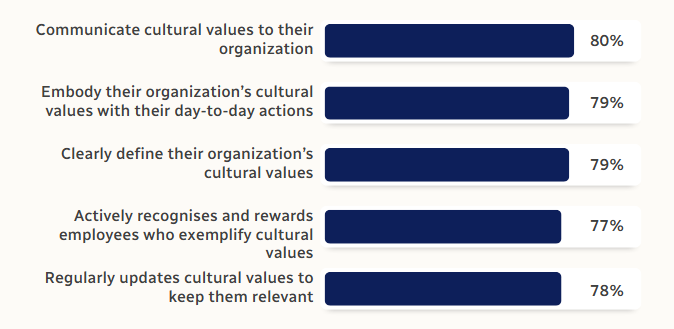
For example, 80% office workers surveyed say their leadership team communicates cultural values effectively4, and nearly the same percentage, at 79%, say the same is true of the way they embody their organization’s cultural values with their day-to-day actions.4
Q. How effectively, or ineffectively, if at all, does your organization’s leadership team do the following?
More importantly perhaps, business leaders in US appreciate that aligning cultural values with strategic objectives and planning can lead to a significant competitive advantage. By integrating culture into their strategic planning, leaders are setting their organizations up for long-term success.
Culture-driven strategies drive competitive advantage
Almost all (98%) US office workers surveyed report that their organization’s leaders incorporate cultural values such as innovation, inclusion and collaboration into strategic planning5. Even more striking is that almost 3 in 5 say they do this to a great extent.
At the same time, 84% of respondents who are in management and leadership positions state that organizational culture is often6 discussed in board meetings.
Our findings indicate that the level of importance placed on workplace culture in US companies is having a tangible impact on performance. This is evident in the 90% of respondents who say that their workplace culture is important7 to their organization’s overall success, with over two thirds (67%) stating that this is very important.
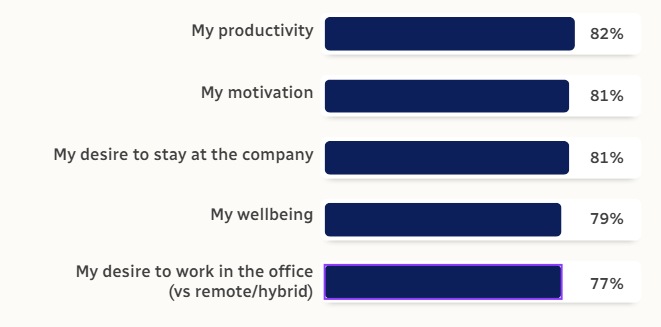
This deep alignment between culture and business strategy is having a measurable impact on employee productivity, motivation, and engagement. In fact, over 4 in 5 US office workers surveyed say their workplace culture helps their productivity8, while a similar percentage, at 81%, say that it helps their motivation.
Q. To what extent does your workplace culture help or hinder the following?
These cultural benefits extend beyond the individual to shape key areas of talent management. A staggering 82% of respondents say their organization’s workplace culture has a positive impact9 on employee engagement and almost 4 in 5 say this is also the case when it comes to employee attraction.
At the same time, the ability for companies to retain their employees is equally strong, with 80% of office workers agreeing that their workplace culture positively impacts employee retention.9
Further findings show that a reason for this is that US companies are actively leveraging workplace culture as part of their employee retention strategies. More than 9 in 10 state that their organizations often engage in activities to align culture for improving long-term employee retention10, such as:
- Transparent communication and open-door policies (40%)
- Team building and social events to enhance employee bonding (40%)
- Flexible working options to support work-life integration (39%)
Overall, the survey results paint a positive picture of workplace culture in the US. Not least because its wide-ranging and positive effects are also reflected in organizations’ balance sheets. According to our research, 79% of respondents believe their organization’s workplace culture positively impacts9 financial results, evidencing the link between culture and profit.
Despite these positive trends, our findings also reveal that culture isn’t immune to deterioration. A significant number of workers have witnessed shifts in workplace culture that negatively impacted morale and performance, signaling that the work to cultivate and sustain a positive culture is ongoing.
79% of survey respondents say their organization’s workplace culture has a positive impact on financial performance
Culture doesn’t thrive on its own
Workplace culture is fragile and requires constant attention. Almost 9 in 10 respondents have experienced cultural deterioration in a workplace.11
According to the results, a number of factors lead to culture deterioration, including high stress levels and unreasonable work demands (32%) and poor handling of conflicts and employee grievances (28%).
But perhaps the most telling factor is ineffective leadership. A quarter of those who have seen culture deterioration in an organization before say a primary cause was a lack of clear leadership and direction. Almost a quarter (24%) say this was due to inconsistent communication from management, while 24% say that a change in leadership or organizational restructuring was the primary cause.
Unfortunately, when culture stops thriving, this can have a detrimental effect on performance, particularly when it comes to talent.
Top three impacts of culture deterioration:
01
Increased turnover and difficulty retaining talent
02
Challenges in attracting new talent
03
Decreased employee morale and job satisfaction
How to safeguard your culture
To prevent cultural decline and ensure it remains a driving force for your organization’s success, you must continuously evaluate and nurture your workplace culture. This effort doesn’t just enhance employee engagement—it has a direct impact on your overall performance. Consider these three key actions to build and maintain a strong, sustainable culture:
01
Align cultural values with strategic objectives
As a business leader, it’s essential that you make culture an integral part of your strategic blueprint. Don’t just align cultural values with your business goals, embed them into the core of your decision-making and execution. Culture should drive your strategic initiatives, from talent acquisition to innovation and client engagement. A robust culture gives you a distinct competitive edge that boosts productivity, morale, and long-term performance, accelerating achieving business goals.

02
Continuously evaluate and adapt cultural strategies
As a leader, you must take a hands-on, continuous approach to assessing and evolving your cultural strategies. This means regularly measuring culture’s impact on performance and swiftly addressing challenges like burnout, unresolved conflicts, or communication breakdowns. By proactively addressing such issues, you ensure your company remains resilient against cultural erosion, protecting your brand, reducing turnover, and attracting high caliber talent even in competitive markets.
03
Foster an inclusive and supportive environment
Inclusivity isn’t just about diversity, it’s about creating an environment where every employee feels they belong and is empowered to contribute their best. As a leader, you must create an environment where collaboration is seamless, employees are motivated, and diversity of thought drives innovation. This supportive atmosphere enhances job satisfaction, while driving financial performance and improving your company’s ability to scale sustainably.
The bottom line? A strong culture is essential for competitive advantage
As these findings show, ensuring a thriving culture is more than a nice-to-have, it’s a business imperative. Companies that prioritize culture are not only more likely to retain the best talent but also be more agile and innovative in the face of change. If you want to sustain a competitive advantage, your culture must be continuously nurtured and aligned with your strategic vision. Don’t wait for culture to fade or deteriorate—be proactive and take the necessary steps to assess, refine, and champion your organizational culture at every level.
To learn more about how we partner with clients to find and attract talent in an increasingly interconnected world, contact Dan Rymer and Naomi Barton.
Research methodology and notes:
Research conducted by Censuswide, on behalf of Redgrave Search with a sample of 1,519 white collar workers in the UK and USA (16+) between 24.10.2024 – 05.11.2024. Censuswide abides by and employs members of the Market Research Society and follows the MRS code of conduct and ESOMAR principles. Censuswide is also a member of the British Polling Council.
1‘Excellent’ and ‘Good’ responses combined.
2‘Strongly agree’ and ‘Somewhat agree’ responses combined.
3‘It’s a top priority’ and ‘It’s a top priority but amongst other things’ responses combined.
4‘Very effectively’ and ‘Somewhat effectively’ responses combined.
5‘To a great extent’ and ‘To a moderate extent’ responses combined.
6‘Every meeting’, ‘Frequently’ and ‘Occasionally’ responses combined.
7‘Very important’ and ‘Important’ responses combined.
8‘My workplace culture significantly helps this (positive affect)’ and ‘My workplace culture somewhat helps this (positive affect)’ responses combined.
9‘Significant positive impact’ and ‘Somewhat positive impact’ responses combined.
10‘Always’, ‘Often’ and ‘Sometimes’ responses combined.
11Reverse of ‘N/A I have not seen culture deterioration in an organization before’.